OmniPresent: Generating Coherent Presentation Suites from Scientific Papers
Qianli Ma1*, Jipeng Xiao1*, Siyu Wang1*, Zhiheng Tian1, Wangyu Feng1,
Chang Guo1, Shibo Wang2, Jin Gao3, Zhipeng Zhang1†
1AutoLab, School of Artificial Intelligence, Shanghai Jiao Tong University ,
2Jilin University, 3Institute of Automation, Chinese Academy of Sciences
Overview
Transforming static research papers into dynamic media like posters, slides, and videos is crucial for dissemination but demands significant effort. Existing automated approaches often treat these formats in isolation, leading to inconsistencies across the presentation suite. We formalize the task of unified presentation suite generation and introduce OmniPresent, a framework designed to orchestrate the creation of coherent deliverables. OmniPresent utilizes a renderable HTML representation for centralized content planning and incorporates a self-correcting verify-and-repair loop to actively resolve conflicts across modalities. To facilitate robust research, we also release OmniPreBench, a comprehensive dataset comprising over a thousand papers with paired artifacts, alongside a rigorous VLM-based evaluation protocol. Our empirical results demonstrate that OmniPresent generates high-quality and faithful presentation suites, significantly surpassing strong baselines in both accuracy and visual appeal. This shift from artifact-centric to unified suite generation is illustrated below.
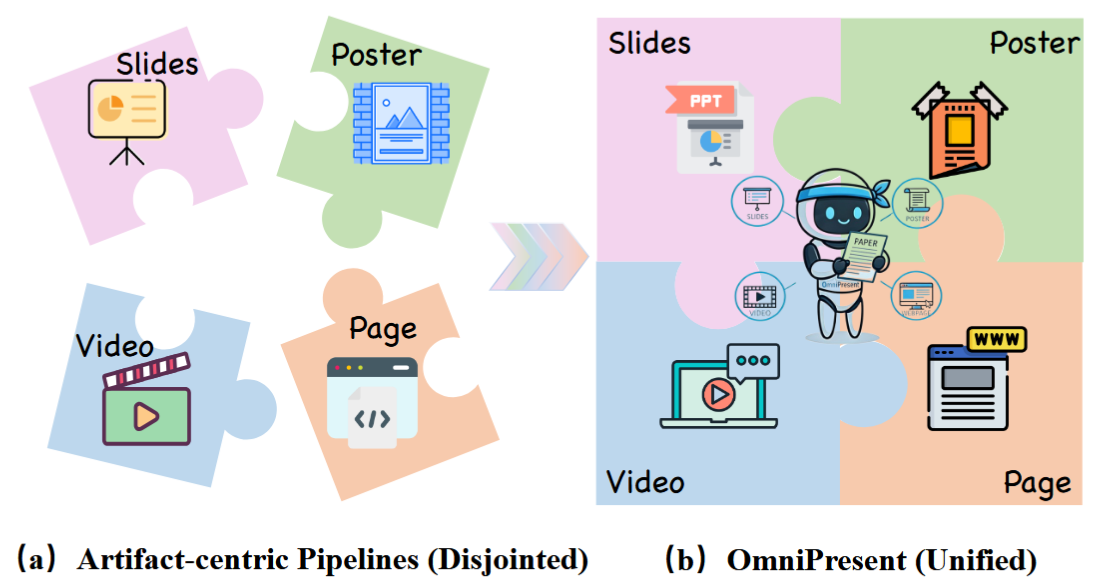
From artifact-centric to unified suite generation. (a) Prior methods typically target a single format with separate parsing, representations, and layout strategies, lacking suite-level crossartifact verification. (b) We unify presentation suite generation into a single framework with shared parsing, planning, and crossartifact verification to produce coherent multi-format deliverables.
Framework
OmniPresent provides a unified framework for transforming scientific papers into coherent presentation suites, such as project pages, posters, slides, and videos. Our approach follows a Plan-Verify-Render paradigm, which is depicted below.
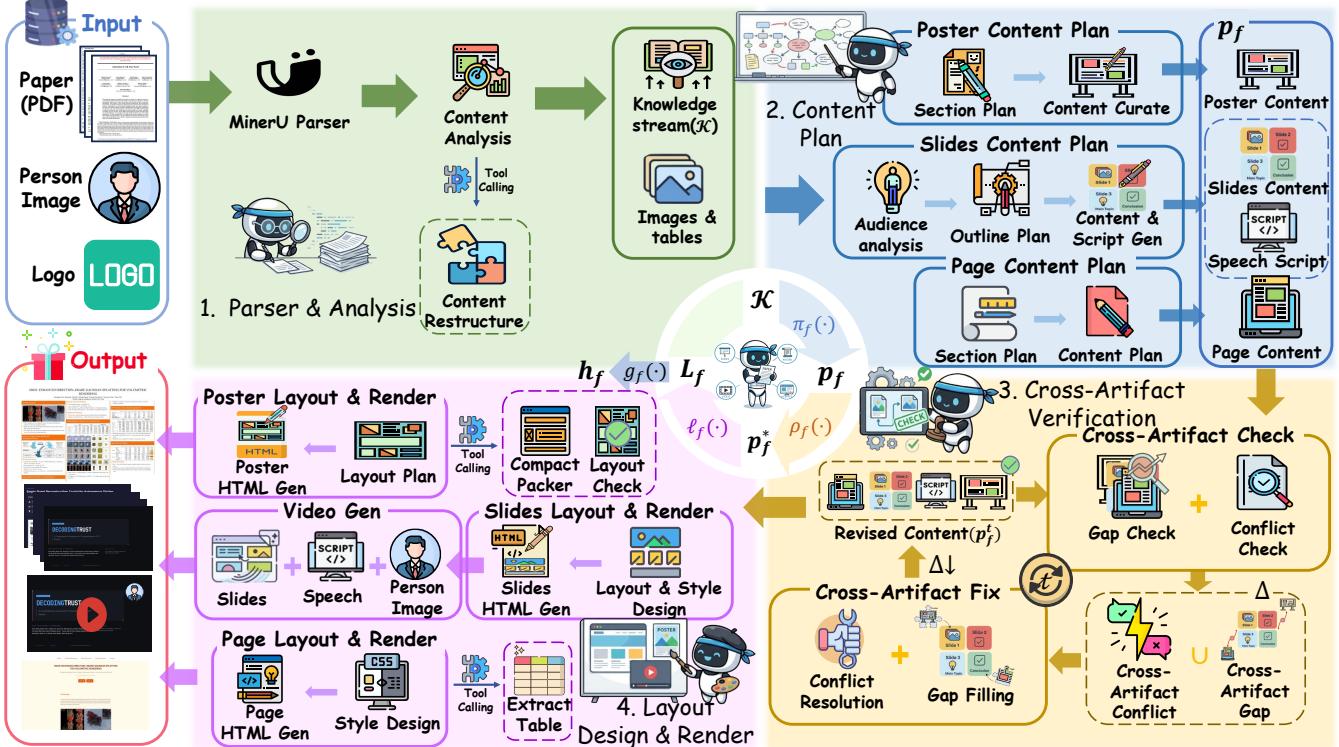
Overview of OmniPresent. Given a paper PDF, the parser and analysis module extracts structured resources and a shared knowledge stream. Format-specific planners draft content for the project page, poster, and slides, while a Cross-Artifact Verification loop detects and fixes conflicts across outputs. Layout and style agents then render each deliverable as executable HTML.
The framework introduces a shared Knowledge Stream to ground all content and a Cross-Artifact Verification loop to ensure suite-level consistency, differentiating it from traditional independent generation frameworks. The generation process involves four key stages:
Extraction: The input paper is parsed into structured resources (text, figures, tables) and an evidence index. These assets are then distilled into a shared knowledge stream ($\kappa$). This centralized representation ensures all downstream planners condition on the same source of truth, minimizing cross-format drift.
Planning: For each target format (PAGE, POSTER, SLIDES, VIDEO), a format-specific planner generates an initial content plan based on the shared knowledge. Each planner is implemented as a chain of specialized sub-agents, handling distinct modality constraints. For instance, the Poster Planner optimizes for spatial information density, while the Slides Planner focuses on adaptive narrative flow.
Verification: This is a core contribution of OmniPresent. A verifier refines the plans by iterating through a Check-and-Fix cycle. A Cross-Artifact Check Agent identifies conflicts (hallucinations or contradictions by cross-referencing claims against the evidence index) and gaps (ensuring salient findings from posters or pages appear in slides). The Cross-Artifact Fix Agent then patches the plans by resolving conflicts and filling gaps. This iterative process ensures consistency and completeness across the suite.
Layout & Rendering: An adaptive layout module translates the verified plan into a layout specification, which is then rendered by a generator into the final executable HTML artifact. This stage decouples semantic planning from visual rendering, allowing content consistency verification to occur before visual output generation. Our adaptive modules accommodate verification-based modifications without breaking rigid templates, utilizing specialized streams for each format (e.g., Poster Stream uses a Compact Packer for optimal visual block arrangement, while the Slides Stream ensures visual hierarchy and consistency).
Benchmark Data
We introduce OmniPreBench, a new benchmark designed to support principled and scalable evaluation of presentation suite generation. OmniPreBench was constructed by crawling AI conference papers from 2023 to 2025, retaining only entries with a complete suite of publicly available dissemination artifacts (paper PDF, project page, poster, slide deck, and presentation video). This process yielded 1,046 qualified papers covering diverse topics and modalities. From this pool, a 50-paper test set was curated, prioritizing diversity and impact through semantic clustering and stratified sampling based on citation counts.
We evaluate generated artifacts using a multi-dimensional framework, encompassing two top-level dimensions: Content Quality and Visual Quality. The evaluation suite design is illustrated below.
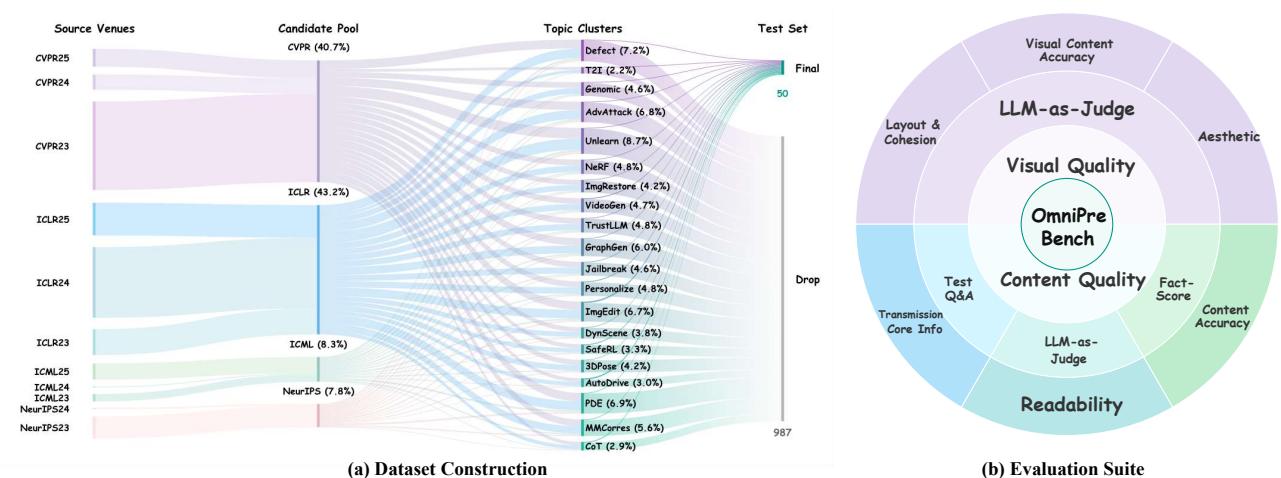
Overview of OmniPreBench. (a) Dataset construction and testset curation. Papers are collected from multiple venue-year sources, filtered into a qualified candidate pool, clustered by topic, and then stratified to form the final testset. (b) Evaluation suite design. The inner ring defines two top-level dimensions, Content Quality and Visual Quality. The middle ring shows the evaluation mechanisms (e.g., LLM-as-Judge and QA tests). The outer ring lists the corresponding fine-grained criteria for each dimension.
Content Quality is assessed along three axes using scalable LLM-assisted protocols:
Fact-Score: Measures the preservation of salient paper facts in the generated artifact by verifying if facts extracted from the source paper are entailed by the generated content.
Q&A Test: Evaluates core information transmission by generating question-answer pairs from the source paper and testing if they can be answered correctly using only the generated artifact.
Readability: Scored by an LLM-based rubric assessing clarity, coherence, and fluency.
Visual Quality is evaluated with VLM-assisted protocols across:
Visual Content Accuracy: Checks if visual elements are correctly rendered and semantically aligned with surrounding text.
Layout & Cohesion: Assesses structural organization, spatial distribution balance, and natural reading order.
Aesthetics: Rates overall visual appeal, including typography, color harmony, and professional look-and-feel.
For project pages, we also measure Interaction Validity, which gauges the proportion of functional links that correctly navigate to intended destinations using an automated browsing agent.
Experiments & Results
We evaluated OmniPresent on OmniPreBench, focusing on suite-level quality metrics including evidence-grounded faithfulness, coverage, cross-format consistency, and format compliance. We compared OmniPresent against two categories of baselines: strong closed-source models for end-to-end generation (e.g., Gemini3-Flash, GPT-5.2-mini, Grok4-Fast) and format-specialized agentic systems (e.g., Paper2Poster, EvoPresent, AutoPage). Human-authored artifacts served as a reference. To ensure fair comparisons, we controlled the underlying foundation model, aligning backbones when comparing with proprietary LLMs and specialized systems.
Our main results, presented below, demonstrate that OmniPresent systematically improves both content faithfulness and visual presentation across all formats with a fixed backbone model, indicating that the gains stem from our suite-level pipeline.
Slides
| Method | Content | Visual | Compression | ||||
|---|---|---|---|---|---|---|---|
| FactScore↑ | Readability↑ | QA↑ | Content acc↑ | Aesthetics↑ | Layout↑ | Compression Rate | |
| Human-authored | 0.716 | 3.26 | 0.711 | 2.22 | 3.53 | 3.10 | 12.62 |
| EvoPresent-Gemini-3-flash | 0.666 | 3.38 | 0.713 | 1.74 | 3.38 | 2.60 | 24.96 |
| GPT-5-mini | 0.751 | 3.00 | 0.716 | 2.27 | 3.00 | 2.85 | 6.92 |
| OmniPresent-GPT-5-mini | 0.830 (+0.079) | 3.20 (+0.20) | 0.724 (+0.008) | 2.84 (+0.57) | 3.89 (+0.89) | 3.49 (+0.64) | 6.74 |
| Gemini-3-flash | 0.585 | 3.18 | 0.707 | 1.94 | 2.39 | 2.33 | 15.18 |
| OmniPresent-Gemini-3-flash | 0.816 (+0.231) | 3.40 (+0.22) | 0.751 (+0.044) | 2.75 (+0.81) | 4.53 (+2.14) | 3.54 (+1.21) | 8.55 |
| Grok-4.1-fast | 0.691 | 2.98 | 0.705 | 2.04 | 2.00 | 2.29 | 11.95 |
| OmniPresent-Grok-4.1-fast | 0.827 (+0.136) | 3.08 (+0.10) | 0.723 (+0.018) | 2.12 (+0.08) | 3.08 (+1.08) | 2.33 (+0.04) | 8.55 |
Poster
| Method | Content | Visual | Compression | ||||
|---|---|---|---|---|---|---|---|
| FactScore↑ | Readability↑ | QA↑ | Content acc↑ | Aesthetics↑ | Layout↑ | Compression Rate | |
| Human-authored | 0.733 | 3.43 | 0.710 | 3.05 | 3.50 | 3.02 | 15.34 |
| Paper2Poster-Gemini-3-flash | 0.470 | 3.50 | 0.659 | 2.88 | 2.05 | 3.00 | 5.33 |
| GPT-5-mini | 0.766 | 3.00 | 0.730 | 2.85 | 2.27 | 2.85 | 5.35 |
| OmniPresent-GPT-5-mini | 0.779 (+0.013) | 3.46 (+0.46) | 0.746 (+0.016) | 3.26 (+0.41) | 3.79 (+1.52) | 2.96 (+0.11) | 3.30 |
| Gemini-3-flash | 0.585 | 3.44 | 0.695 | 2.43 | 3.63 | 3.02 | 20.29 |
| OmniPresent-Gemini-3-flash | 0.755 (+0.170) | 3.60 (+0.16) | 0.716 (+0.021) | 3.16 (+0.73) | 3.76 (+0.13) | 3.20 (+0.18) | 3.75 |
| Grok-4.1-fast | 0.702 | 3.18 | 0.713 | 2.06 | 2.59 | 2.55 | 12.82 |
| OmniPresent-Grok-4.1-fast | 0.754 (+0.052) | 3.22 (+0.04) | 0.717 (+0.004) | 3.10 (+1.04) | 3.73 (+1.14) | 3.04 (+0.49) | 3.21 |
Page
| Method | Content | Visual | Interaction | Compression | ||||
|---|---|---|---|---|---|---|---|---|
| FactScore↑ | Readability↑ | QA↑ | Content acc↑ | Aesthetics↑ | Layout↑ | Success↑ | Compression Rate | |
| Human-authored | 0.721 | 3.12 | 0.706 | 3.40 | 3.20 | 3.46 | 1.00 | 10.89 |
| AutoPage-Gemini-3-flash | 0.705 | 3.10 | 0.701 | 2.90 | 2.07 | 3.35 | 0.66 | 3.28 |
| GPT-5-mini | 0.741 | 3.06 | 0.710 | 1.82 | 3.25 | 3.56 | 0.04 | 4.78 |
| OmniPresent-GPT-5-mini | 0.801 (+0.060) | 4.48 (+1.42) | 0.714 (+0.004) | 3.28 (+1.46) | 3.45 (+0.20) | 3.66 (+0.10) | 0.76 (+0.72) | 8.84 |
| Gemini-3-flash | 0.485 | 3.08 | 0.699 | 1.14 | 3.46 | 3.02 | 0.02 | 13.13 |
| OmniPresent-Gemini-3-flash | 0.782 (+0.297) | 3.62 (+0.54) | 0.712 (+0.013) | 3.12 (+1.98) | 3.59 (+0.13) | 3.96 (+0.94) | 0.92 (+0.90) | 6.98 |
| Grok-4.1-fast | 0.666 | 2.78 | 0.703 | 1.40 | 3.22 | 3.60 | 0.04 | 9.60 |
| OmniPresent-Grok-4.1-fast | 0.791 (+0.125) | 3.66 (+0.88) | 0.747 (+0.044) | 3.42 (+2.02) | 3.63 (+0.41) | 3.94 (+0.34) | 0.72 (+0.68) | 12.38 |
Video
| Method | FactScore↑ | Readability↑ | QA↑ |
|---|---|---|---|
| Human-authored | 0.849 | 3.51 | 0.759 |
| EvoPresent-Gemini-3-flash | 0.687 | 3.50 | 0.732 |
| OmniPresent-Gemini-3-flash | 0.865 (+0.179) | 3.53 (+0.03) | 0.773 (+0.041) |
| OmniPresent-GPT-5-mini | 0.856 (+0.170) | 3.39 (-0.11) | 0.757 (+0.025) |
| OmniPresent-Grok-4.1-fast | 0.813 (+0.126) | 3.24 (-0.26) | 0.746 (+0.014) |
Main evaluation results across our full suite of OmniPreBench. We report content quality (FactScore, Readability, QA), visual quality (visual content accuracy, aesthetics, layout), interaction success rate (Page only), and compression rate (higher indicates less redundancy). For each proprietary backbone, we compare end-to-end generation with OmniPresent instantiated using the same backbone; values in parentheses denote the absolute gains of OmniPresentover its matched end-to-end baseline.
We observed consistent improvements over end-to-end baselines in factuality (FactScore), information transmission (QA), and visual presentation across all three formats and backbones. For instance, with GPT-5.2-mini, OmniPresent increased FactScore from 0.751 to 0.830 (+0.079) for slides and Aesthetics from 3.00 to 3.89 (+0.89). These improvements were particularly pronounced in visual metrics, validating the effectiveness of our Adaptive Layout Agent. Our unified pipeline also outperformed strong format-specialized systems, demonstrating that suite-level generation does not sacrifice per-format quality. For example, OmniPresent surpassed EvoPresent in FactScore (0.830 vs. 0.666) and QA Accuracy (0.724 vs. 0.713) for slides, and outperformed Paper2Poster across all metrics for posters, notably in Visual Content Accuracy (3.79 vs. 2.88). This supports our hypothesis that sharing a centralized Knowledge Stream and performing Cross-Artifact Verification improves individual artifact quality by grounding them in a unified evidence index.
Furthermore, OmniPresent achieved a significantly higher Interaction Success rate for project pages compared to baselines, attributed to Evidence Indexing that grounds external links and precise resource mapping during rendering. For video generation, as shown below, OmniPresent consistently outperformed EvoPresent, especially in FactScore and QA Accuracy, due to its unified knowledge stream providing more reliable grounding for temporal content.
An ablation study confirmed the critical role of the Cross-Artifact Verification (CV) module. Removing CV led to a consistent decline in FactScore and QA Accuracy across all formats, as shown below.
| Setting | Method | Content Quality | Compression | ||
|---|---|---|---|---|---|
| FactScore↑ | Readability↑ | QA↑ | Rate | ||
| Page | w/o CV | 0.782 | 3.44 | 0.698 | 3.67 |
| w/ CV | 0.810 (+0.028) | 3.42 (-0.02) | 0.712 (+0.014) | 3.75 | |
| Slides | w/o CV | 0.774 | 3.48 | 0.718 | 6.58 |
| w/ CV | 0.816 (+0.042) | 3.48 (+0.00) | 0.750 (+0.032) | 6.98 | |
| Poster | w/o CV | 0.732 | 3.58 | 0.700 | 8.31 |
| w/ CV | 0.755 (+0.023) | 3.60 (+0.02) | 0.716 (+0.016) | 8.55 | |
| Video | w/o CV | 0.793 | 3.52 | 0.732 | 6.81 |
| w/ CV | 0.865 (+0.072) | 3.53 (+0.01) | 0.773 (+0.041) | 6.03 | |
Ablation study on Cross-Artifact Verification (CV). We add CV to OmniPresent (Gemini-3-Flash backbone) and report the absolute change w.r.t. w/o CV in parentheses.
This validates the 'Verify-and-Repair' loop's ability to identify and rectify hallucination drifts and ensure higher information coverage. Qualitative case studies further illustrate OmniPresent's suite-level advantages compared to artifact-centric baselines, which often suffer from significant visual rendering failures. For example, our method produces a more coherent presentation suite with stronger cross-modal alignment in key regions, whereas baselines often exhibit missing content, layout imbalance, or disproportionate visual elements.
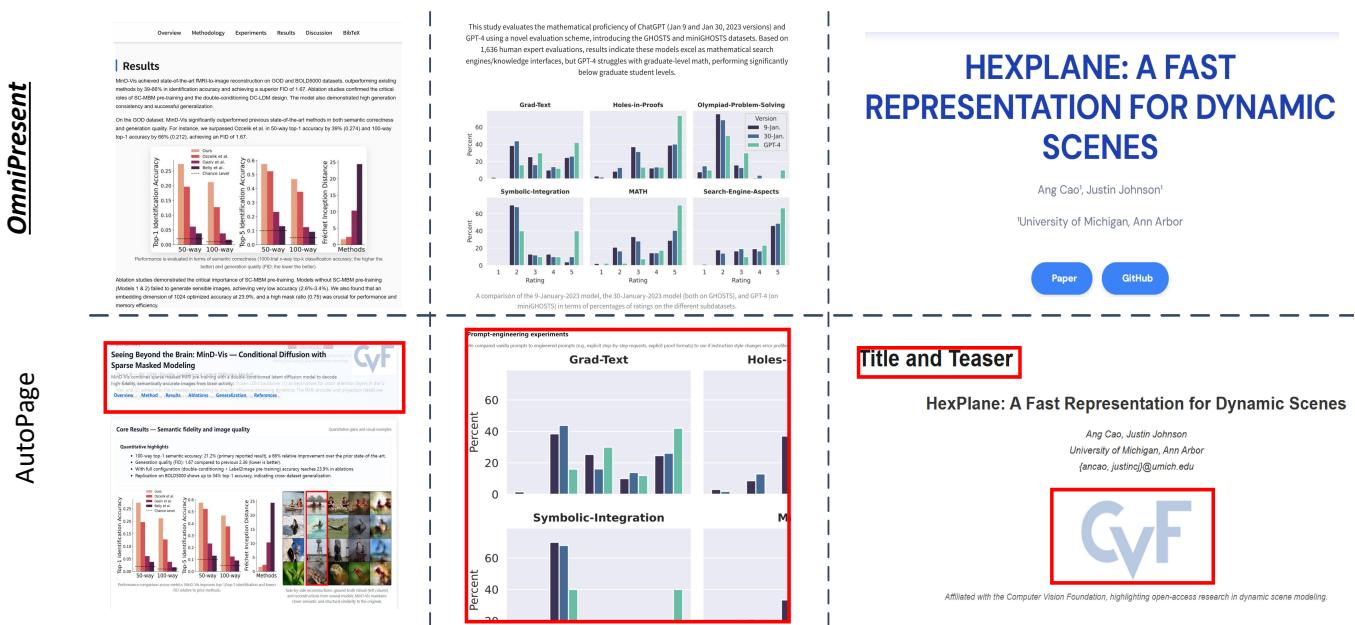
Qualitative comparison between our system (top) and a prior system (bottom). On the same paper, our method produces a more coherent presentation suite (page/poster/slides) with stronger cross-modal alignment in key regions (e.g., Title & Teaser, plots, and overall layout), whereas the baseline more often exhibits missing content, layout imbalance, or disproportionate visual elements. Red boxes highlight representative differences.
Our method generates more structured and visually consistent posters with better content coverage and layout balance, while baselines often suffer from sparse organization, uneven whitespace usage, and reduced cross-section coherence.
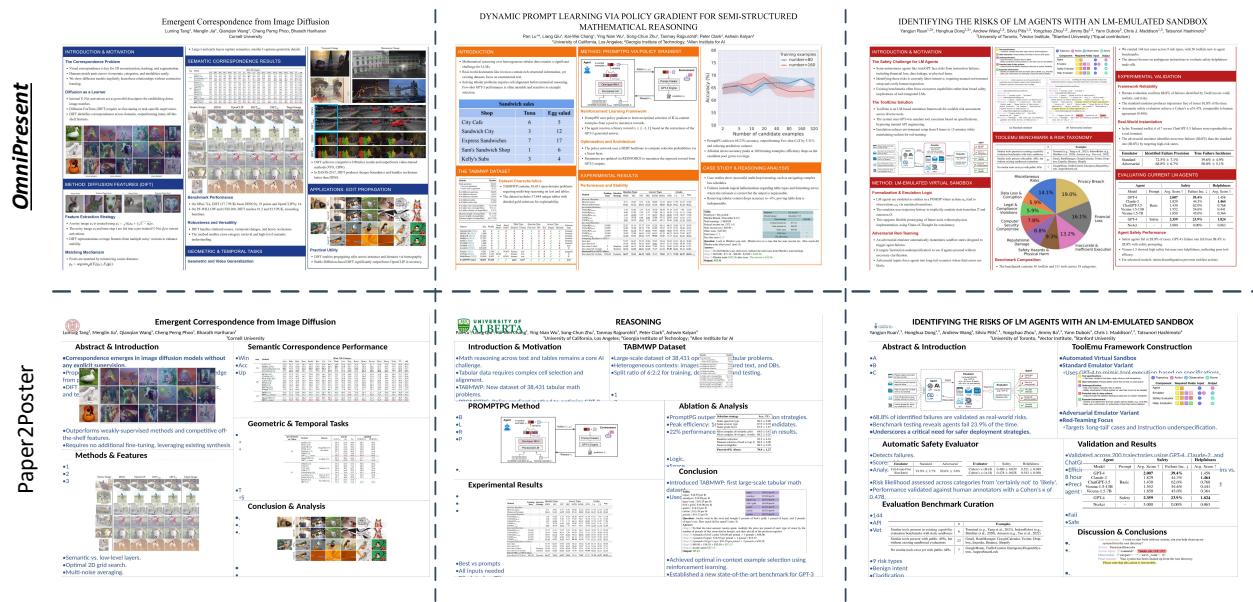
Qualitative comparison between our system (top) and a prior system (bottom) across multiple papers. Our method generates more structured and visually consistent posters with better content coverage and layout balance, while the baseline often suffers from sparse organization, uneven whitespace usage, and reduced cross-section coherence. The dashed grid indicates matched paper cases for side-by-side comparison.
For slides, our method produces cleaner, more information-dense slides with consistent typography, alignment, and visual hierarchy, unlike baselines that often leave large unused regions or exhibit weaker content-to-layout utilization.
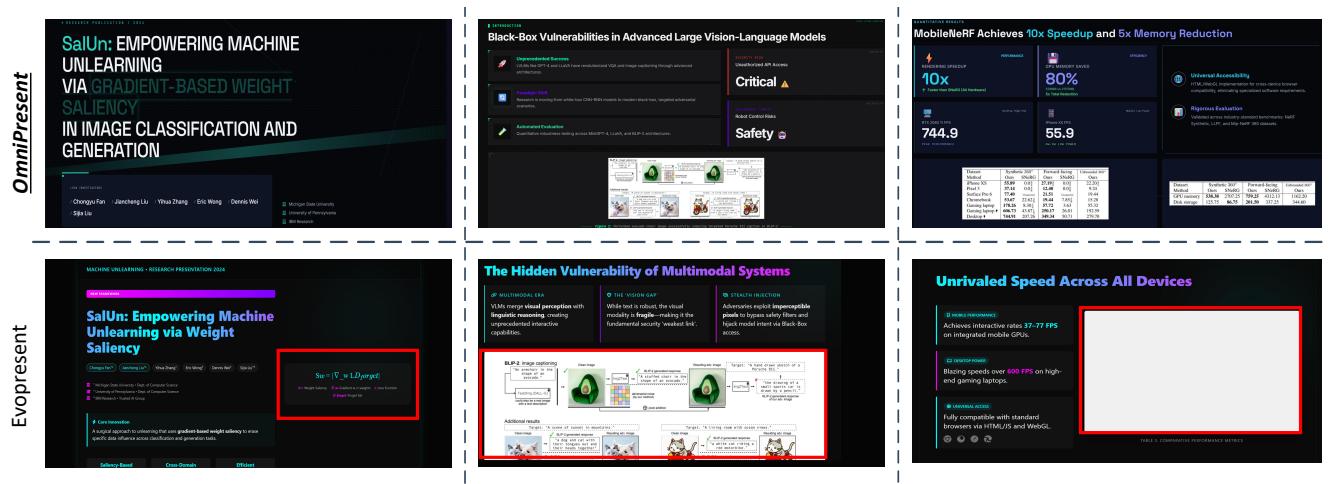
Qualitative comparison of slide generation between our system (top) and EvoPresent (bottom). Across multiple papers, our method produces cleaner, more information-dense slides with consistent typography, alignment, and visual hierarchy, while EvoPresent often leaves large unused regions (highlighted in red) or exhibits weaker content-to-layout utilization. Dashed separators indicate matched slide cases for side-by-side comparison.
Overall, OmniPresent generates coherent page–poster–slide suites with better content density, consistent visual hierarchy, and stronger cross-asset alignment, while end-to-end baselines often waste large regions, introduce layout inefficiencies, or lose key information.
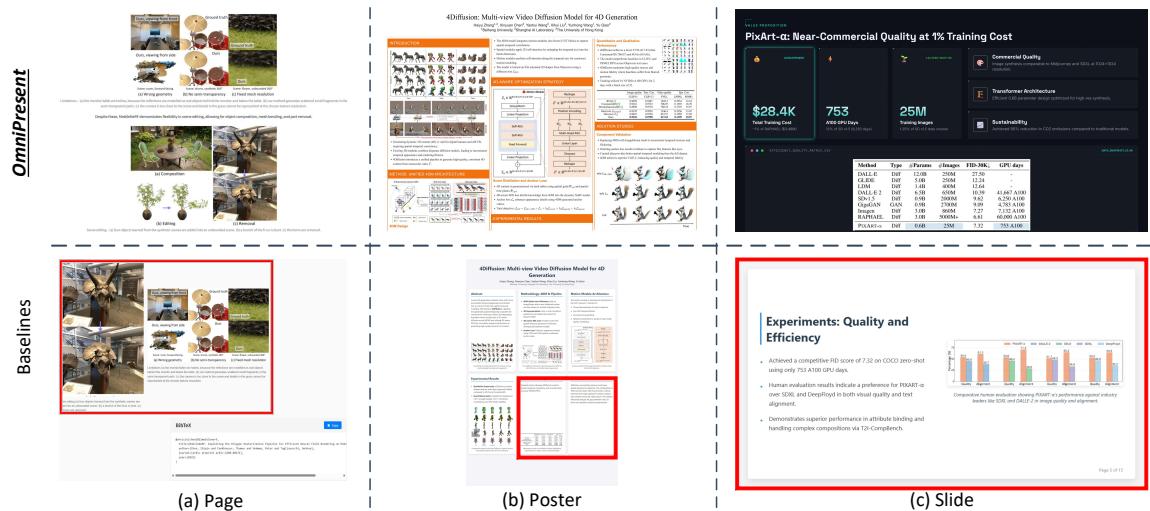
Qualitative comparison with end-to-end baselines. Top: our system (OmniPresent) generates coherent page–poster–slide suites with better content density, consistent visual hierarchy, and stronger cross-asset alignment. Bottom: end-to-end baselines often waste large regions, introduce layout inefficiencies, or lose key information (highlighted in red). (a–c) show representative examples for Page, Poster, and Slide. Dashed separators indicate matched cases across methods.
Conclusion
We introduced OmniPresent, a unified system designed to generate a coherent presentation suite, including a project page, poster, slides, and video, all in executable HTML format, directly from a single scientific paper. Our core mechanism ensures consistency across different formats by leveraging shared parsing and content planning, with each generated artifact grounded in the original scientific paper. A novel cross-artifact verification loop is employed to detect and resolve conflicts, significantly improving fidelity and reducing cross-format drift during artifact generation. To support principled and large-scale evaluation of this suite-level task, we developed OmniPreBench, a new benchmark comprising paired multi-format artifacts from recent AI conference papers. Extensive experiments demonstrate that OmniPresent consistently improves groundedness and suite-level consistency, outperforming strong independent-generation baselines. We believe this work will significantly contribute to future progress in reliable and scalable scientific communication.
待填入bibtex